

This is a Respectable Weird Publication
The Roots of High Weirdness

“If you sincerely desire a truly well-rounded education, you must study the extremists, the obscure, and “nutty.” You need the balance! Your poor brain is already being impregnated with middle-of-the-road crap, twenty-four hours a day, no matter what. Network TV, newspapers, radio, magazines at the supermarket… even if you never watch, read, listen, or leave your house, even if you are deaf and blind, the telepathic pressure alone of the uncountable normals surrounding you will ensure that you are automatically well-grounded in consensus reality.”
― Ivan Stang, High Weirdness By Mail
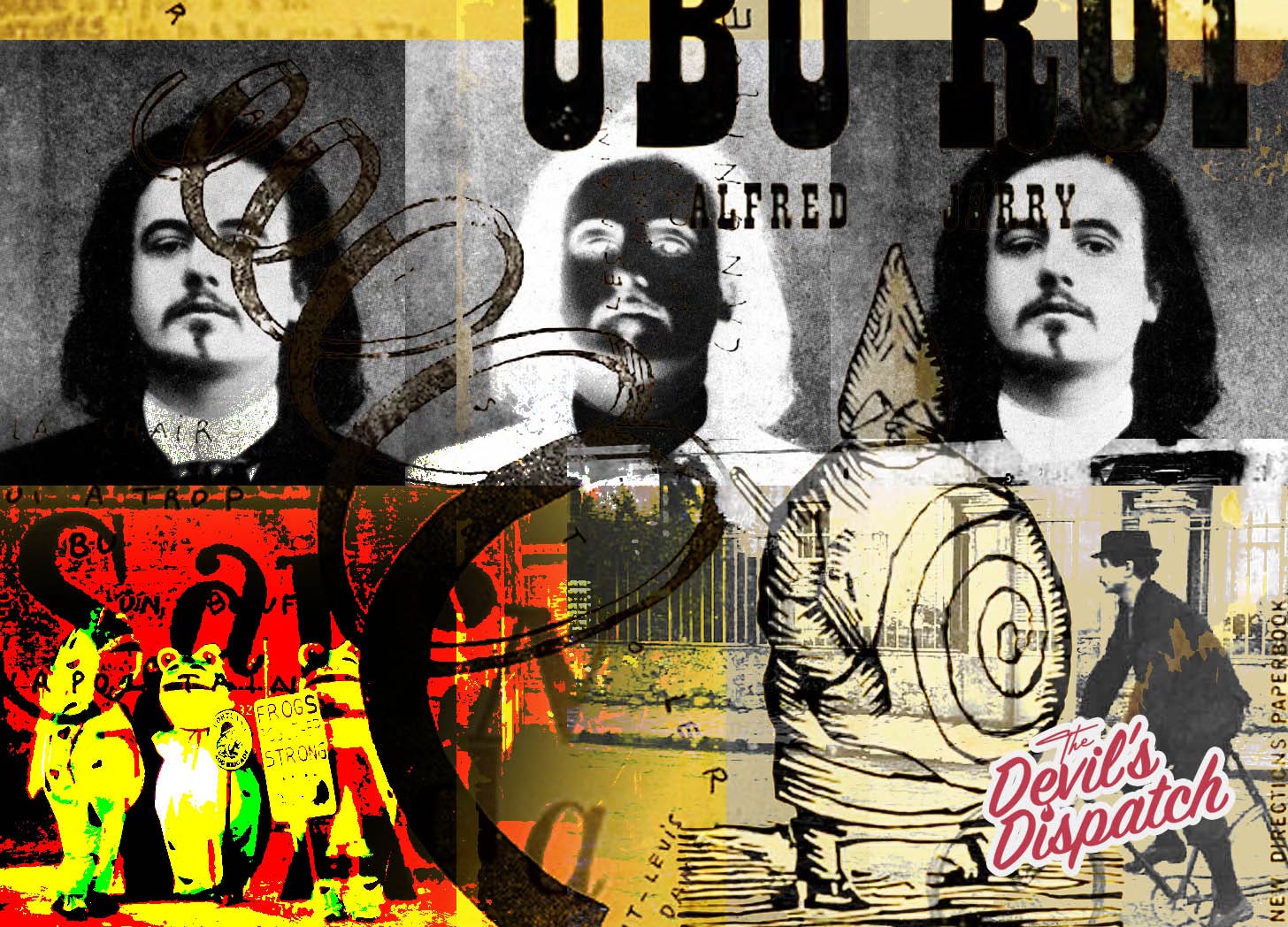
There was a time long ago, when The Backstreet Boys topped the charts, and spiky frosted tips were the norm, and dare I say, encouraged.
Yes, I’m talking about the early 2000s.
It was a confusing time of dial-up modems, Britney, and 800 x 600 monitor resolutions. For those of us who reached our formative years during that period, it was also a time straddling the pre- and post-Internet world that exposed us millennials to page after page of animated GIFs and midi files.
Nestled amongst the nauseating flashing pixels, one could find the remains of a variety of delightful strangeness: the Church of the SubGenius1, TOPY, Deoxy, and the Zine movement all revealed a world much different (and more interesting) than the one your regular working-class parents lived in. For the weird kids, it was like a gift from the gods to discover that there were other people out there who didn’t just settle for a life of endless mindless consumption and lack of fulfillment.
Sadly, by the end of that decade, many of these groups had fizzled out as the internet moved to a walled garden model, with just a few platforms snapping up all the user-generated content with the aim of monetizing it. They were successful, and not long after, the internet transitioned into a space largely filled with content curated or outright created by marketing firms for the benefit of metrics, and commented on by paid-for botnets. The internet was dead.
High Weirdness: A very brief introduction
The term High Weirdness was popularized in Ivan Stang's 1988 book High Weirdness by Mail, which was essentially a directory of fringe publications on topics like UFOs, drug culture, extreme religion, far-left and right politics, and conspiracy forums.

Since then, High Weirdness has come to include various subjects that fall outside the mainstream cultural paradigm, usually referring to work by authors such as Philip K. Dick and Robert Anton Wilson, and the works of various occult and fringe authors. All of these groups had one thing in common: they shrugged the cultural status quo in favor of the creation of artifacts, writings, and performances that often embodied the uncomfortable in hopes that the rest of us would see things in a slightly different light. Because these irreverent artifacts are often created by people outside the mainstream narrative framework who reject the current systems, High Weirdness is often decentralized and distributed, open source, mystical, and anti-capitalist.
High Weirdness, at its core, is a subversive contrasting agent to the mainstream.

The exuberant digital flowering of anti-establishment sentiment in the 1980s and 90s, and to a smaller extent the early 2000s, was just the most recent revival of an energetic current that started during a time and in a place that was also marked by rapid technological and social upheaval, the Belle Époque era of 1880s France.
Joan was quizzical, studied ‘pataphysical
On a Parisian winter day in December of 1896, a crowd gathered in front of the ornate facade of the Théâtre de Paris to wait for the premiere of a new satirical play, Ubu Roi. Amongst the waiting crowd of patrons was poet and Hermetic Order of the Golden Dawn member William Butler Yeats, along with French man of letters Catulle Mendès, future Nobel prize winner André Gide, artist Henri de Toulouse-Lautrec, and philosopher-poet Paul Valéry. As the crowd shuffled in and settled into their seats, the curtain drew back to reveal a comically grotesque figure surrounded by cartoonish abstract scenery. The figure proceeded to yell what was essentially a mix of the French words for “shit” and “fuck” to the audience.
The play that followed was a mockery of authority that did not follow conventional storytelling in any sense. The crowd rioted. Literally.
French anarchist and art critic Félix Fénéon wrote in his review of the play:
“Never has a theatrical performance produced such a din... shrieks, whistles, the most varied protests.”
Which is the 1890s way of saying people fucking hated it, and they made that hatred immediately known. With their fists.
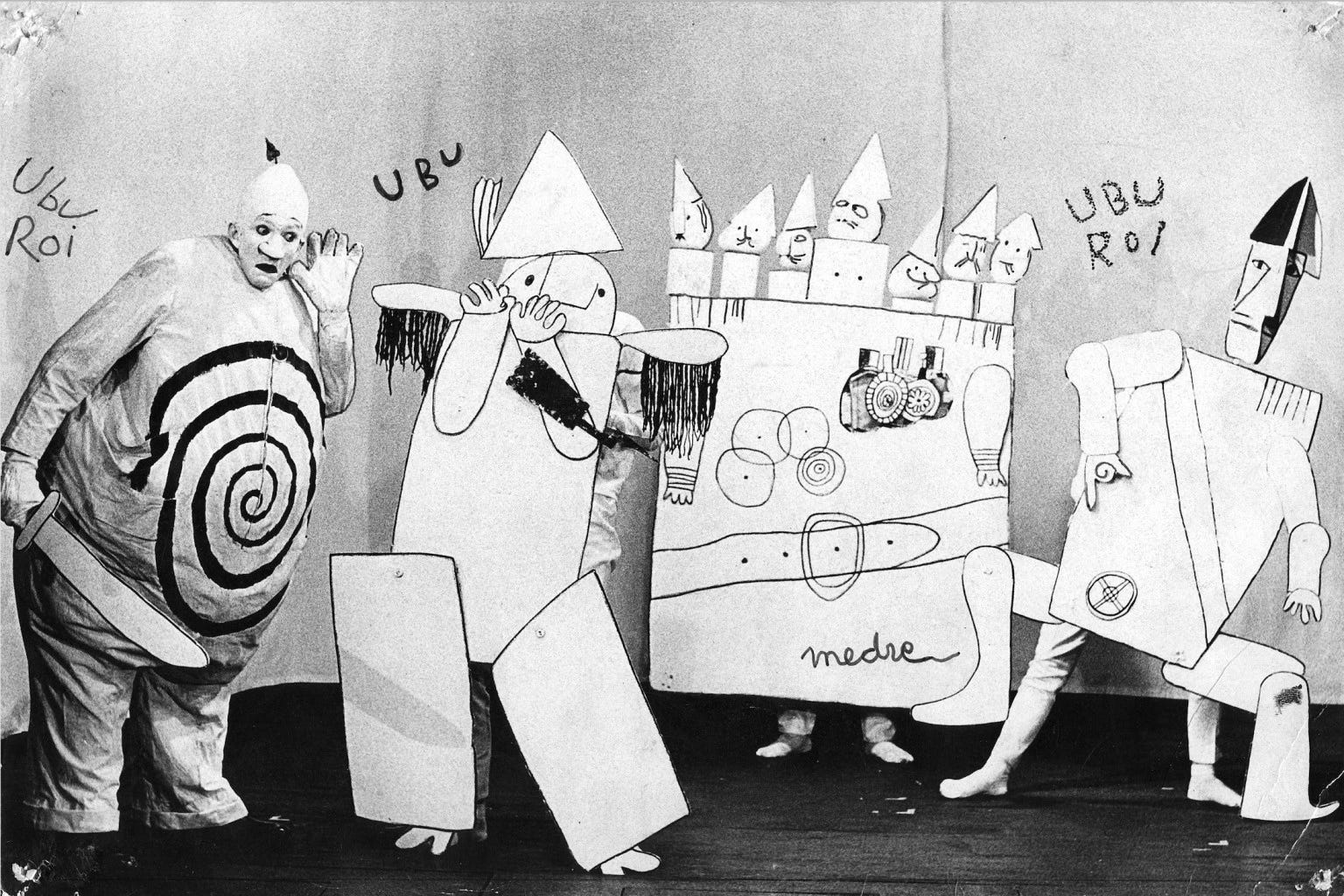
Between the alleged fist-fights and the screaming crowd, something magical had taken place. A play, written by 23-year-old Alfred Jarry, making fun of the establishment, had sparked the beginning of a totally different way of thinking about the world. It was the advent of Modernism, opening the door for movements like Dadaism and Surrealism that were soon to follow.
Alfred Jarry, as a person, was annoying. He spoke in frustrating absurdity and adopted a nasally, high-pitched speaking voice that others found incredibly abrasive. He once painted his face green and rode through the streets on his bicycle in honor of his muse, absinthe. His tiny apartment which was subdivided horizontally rather than vertically (guests had to crouch to fit, Jarry was quite short and barely stand) was filled with empty bottles, guns, and books. Contemporary intellectual and writer André Gide wrote of Jarry:
“He refused to live in the world as others did; he transformed it according to his whims. Reality was an insult to him.”
Part of this transformation of reality for Jarry was the invention of the science of ‘pataphysics. Jarry mandated that the word always have an apostrophe before the letter “p”, denoting the word as being a contraction of the Greek phrase “τὰ ἐπὶ τὰ μεταφυσικά (tà epì tà metaphusiká) meaning that which is above metaphysics. It was a tongue-in-cheek reference to Aristotle’s Metaphysics. According to one of over 100 official definitions of the science, 'pataphysics deals with “the laws which govern exceptions and will explain the universe supplementary to this one.” In ‘pataphysics, every event in the universe is accepted as an extraordinary event. Although Jarry passed away in 1907 at the age of 34, ‘pataphysics went on to be a major influence in music, cinema, and literature that continues into the modern era.
Jarry’s 'pataphysics and the artistic output of his Symbolist contemporaries at the turn of the century are best understood as a rebellion against a time period where most visual and written works of art were largely based on realism. The Symbolists sought to create an alternative narrative that centered on the internal, dreamlike wellspring of thought and emotion during a time when rapid advances in science were solidifying a rigid view of the world. Only once this step had been taken could Surrealism, Cubism, Dada, and the psychedelic consciousness exploration movements of the latter half of the 20th century follow.
A Sensation of Wrongness
To see the through-line between Ubu Roi and High Weirdness by Mail, we must examine the definition of the Weird.
To quote Mark Fisher2, weirdness:
involves a sensation of wrongness: a weird entity or object is so strange that it makes us feel that it should not exist, or at least it should not exist here. Yet if the entity or object is here, then the categories which we have up until now used to make sense of the world cannot be valid. The weird thing is not wrong, after all: it is our conceptions that must be inadequate.
High Weirdness, then, is the employment of drawing attention to this wrongness for the betterment of society, or at least of the removal of the more unsavory bits. It’s no surprise then that weirdness as a cultural tool seems to pop into the mainstream during times of social and economic distress. All expressions of high weirdness are means to an end, a way of breaking the reality tunnel so that new structures can replace those that are no longer serving humanity.
In many ways, to willingly engage in High Weirdness is to embrace a more authentic view of reality, one that many people look away from to avoid uncomfortable introspection or the need to engage with difficult topics. It is a multiplicity of unapproved thought-forms, modes of being, alternate states of consciousness, and artistic expression that is at best frowned upon and at worst outright banned by the establishment and authoritarian governments. Why? Because the control structures can only function if you don’t look away from the approved reality tunnel.
While it seems that the current iteration of the internet is dead or dying and cannot be relied upon for free expression, and apathy towards the rapidly evaporating freedom from surveillance and state-sponsored conformity is at an all-time high, we must hope that it is merely setting the stage for a return of high weirdness.
I think it has already begun.

I’ll leave you with this quote by Philip K. Dick:
The authentic human being is one of us who instinctively knows what he should not do, and, in addition, he will balk at doing it. He will refuse to do it, even if this brings down dread consequences to him and to those whom he loves. This, to me, is the ultimately heroic trait of ordinary people; they say no to the tyrant and they calmly take the consequences of this resistance. Their deeds may be small, and almost always unnoticed, unmarked by history. Their names are not remembered, nor did these authentic humans expect their names to be remembered. I see their authenticity in an odd way: not in their willingness to perform great heroic deeds but in their quiet refusals. In essence, they cannot be compelled to be what they are not.
If you want to further explore the convergence of societal change, art, and the conditions that gave rise to authoritarianism in pre-WWII Germany, click the button below to check out the newest episode of Dispatches From Post-Reality.
Learn from history, or you are doomed to repeat it. But some events may be impossible to avoid as momentous forces converge upon a single point in time with leaders wholly unequipped to handle them. For this episode, the bois take a trek through history and visit the Weimar Republic, a bureaucratic state whose inadequacies would reverberate for decades to come. They educate themselves on the culture, economy, and people of 1920s Germany so that they can glean insight into how modern-day events may unfold. So, are we on the precipice of going down the same road, or can we swerve onto the historical off-ramp and avoid ruin? Only time will tell.

The SubGenii are still somewhat active, and you can still be ordained as a follower of Bob as far as I know.
http://k-punk.abstractdynamics.org
Eureka! I have found Deoxy.org again at last, thanks to you.
Combing through that site made such an impact on my adolescent brain circa 1997-1999 but it was lost to the sands of times after many browser bookmarks migrations.
I had wanted to revisit it for maybe 5 or 6 years now but I couldn’t seem to find any traces of it anywhere.
I kinda worried that the content might feel dated and irrelevant now but, my gods, it does not. “A Citizen Agenda to Tame Corporate Power, Reclaim Citizen Sovereignty,
and Restore Economic Sanity,” for example, feels even more on-the-nose now, and even prescient of all the nonsense we’re living through now.